Why Are Harmonic Joint Modules "the Most Popular"?
2026-01-30
Who Is Actually Producing Harmonic Joint Modules?
At the recently concluded CES 2026 (International Consumer Electronics Show 2026), a wide range of high-performance hardware such as humanoid robots and dexterous hands captured widespread attention.
When attention is focused on the smooth movements and scenario adaptability of complete robotic systems, few people notice that the core supporting all of this precise interaction is the joint actAt the recently concluded CES 2026 (International Consumer Electronics Show 2026), a wide range of high-performance hardware such as humanoid robots and dexterous hands captured widespread attention.
When attention is focused on the smooth movements and scenario adaptability of complete robotic systems, few people notice that the core supporting all of this precise interaction is the joint actuation system, which integrates precision transmission, torque sensing, and high-efficiency drive technologies. This has become the invisible battlefield where manufacturers compete.
During the exhibition, most attention was drawn to LG’s launch of its new humanoid robot, CLOiD. At the same time, LG also introduced an actuator brand, LG Actuator AXIUM™, designed specifically for service robots, which may have gone largely unnoticed.
Another humanoid robot from South Korea, Alice4, adopts linear actuators with impressive specifications. According to official data, two configurations are available, with weights of 0.9 kg and 1.1 kg, sizes of 70 mm and 100 mm, and peak thrust forces of 668 N and 1520 N respectively.
If one asks why almost all humanoid robot companies are pushing hard on parameters such as joint module noise, peak force, and torque density, companies like 1X, Figure AI, and Boston Dynamics—representing home and industrial scenarios—have already provided their answers.
1X stated: “NEO operates at only 22 decibels—quieter than a modern refrigerator. It uses 1X’s patented tendon-driven actuator system, designed specifically for gentle motion around humans.”
Figure AI stated: “One key reason why Figure 03 is well suited for commercial applications is that its actuators operate at twice the speed while increasing torque density (Nm/kg). The most notable result is that Figure 03 can perform pick-and-place operations more quickly.”
BHaozhi Robotics unveiled its latest integrated harmonic reducer joint moduleoston Dynamics stated: “Atlas weighs 89 kg, has 28 joints, and achieves a torque density of 220 Nm/kg with foot positioning accuracy of less than 10 cm. These specifications translate theoretical capability into practical industrial applications.”
In these specific robot examples, the choice of joint module technology route often depends on actual application scenarios. In terms of performance, joint modules define the hardware-level upper limits of what humanoid robots can do—and how well they can do it.
2025 Harmonic Joint Module New Products
In China, planetary joint modules and harmonic joint modules are currently the most common technical routes.
According to incomplete statistics from Gaogong Humanoid Robotics, throughout 2025, a total of 11 new harmonic joint modules, 12 planetary joint modules, 4 cycloidal joint modules, and 3 linear joint modules were launched domestically.
According to incomplete statistics from the Gaogong Robot Industry Research Institute (GGII), the combination of harmonic joint modules and planetary joint modules is relatively common in humanoid robots.
As the finale of this new product review series, harmonic joint modules stand out due to the following observation:
Under a development landscape where planetary and harmonic joint modules evolve in parallel, why has such a tilt emerged? Is it because upstream components have sensed a shift in hardware technology routes, or because new demands have emerged from real-world humanoid robot deployment?
In this round of review, Gaogong Humanoid Robotics will first provide a brief introduction to the parameters and performance of these new products. Some products may be omitted, and the ranking is in no particular order.
Leisai Robotics
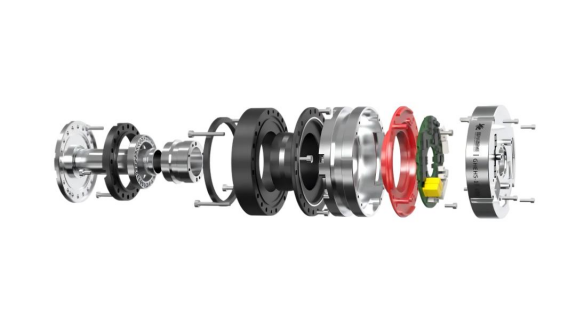
In early December, Leisai Robotics officially released the new lightweight HJ2 harmonic joint module. The product further improves lightweight structure design, high torque density, and system efficiency, and is suitable for key load-bearing joints such as the shoulders, elbows, hips, and knees of humanoid robots. Through the coordinated design of frameless motors, drivers, and encoders, HJ2 offers improved system compatibility.
According to the company, the HJ2 harmonic joint module breaks cost barriers, achieving a 30% price reduction. Through innovative materials, weight is reduced by 65%, power density is doubled, and volume is reduced by 20%. In addition, thanks to the excellent thermal conductivity of aluminum alloy materials, heat generation is reduced by 25% compared with similar products on the market.
Leisai Robotics was founded in 2024 and is located in Jiangqiao, Jiading District, Shanghai. The company focuses on robot core components such as frameless torque motors, drivers, encoders, as well as planetary and harmonic joint module solutions. Its parent company, Leisai Intelligent, was founded in 1997 and has been deeply engaged in the motion control field for 26 years, becoming a globally recognized enterprise in intelligent equipment motion control.
Tongchuan Precision
In September 2025, Tongchuan Precision released its newly developed Harmocore series lightweight harmonic reducer joints, covering six models: TCHL-11M, TCHL-14M, TCHL-17H, TCHL-20H, TCHL-25H, and TCHL-32H. These products feature three core advantages: lightweight design, force-position closed-loop control, and flexible installation design.
Guangzhou Haozhi Industrial Co., LTD
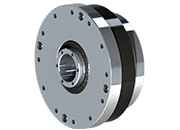
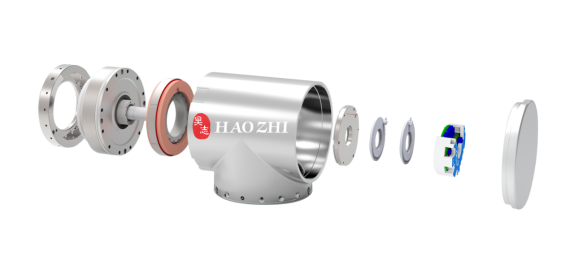
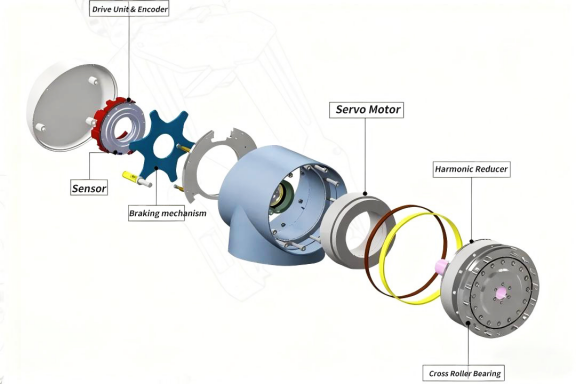
At the China International Industry Fair in September 2025, Haozhi Electromechanical showcased an integrated harmonic reducer joint module, incorporating a high-performance frameless torque motor with 3.5× overload capability.
The module is equipped with high-precision dual absolute encoders, achieving repeat positioning accuracy of up to ±0.003°. Combined with a high-rigidity harmonic reducer and dual multi-turn absolute encoder structure, virtual force control becomes feasible. The harmonic reducer used achieves transmission accuracy of up to 25 arc-seconds.
It is worth noting that in July 2025, Haozhi Electromechanical released the world’s first vibration dimension standard system for harmonic reducers, filling an industry gap and achieving dual technological breakthroughs: a 60% reduction in vibration peak values and a 66.7% improvement in transmission accuracy.
As early as November 2024, Haozhi Electromechanical established a wholly owned subsidiary dedicated to the R&D, production, and sales of robot core components, with a total investment of RMB 60 million. Core products such as harmonic reducers and joint modules have been delivered to some humanoid robot manufacturers for testing and have achieved initial sales, although the current scale remains limited and has little impact on overall performance.
Humanoid Robots Are Defining Joint Modules
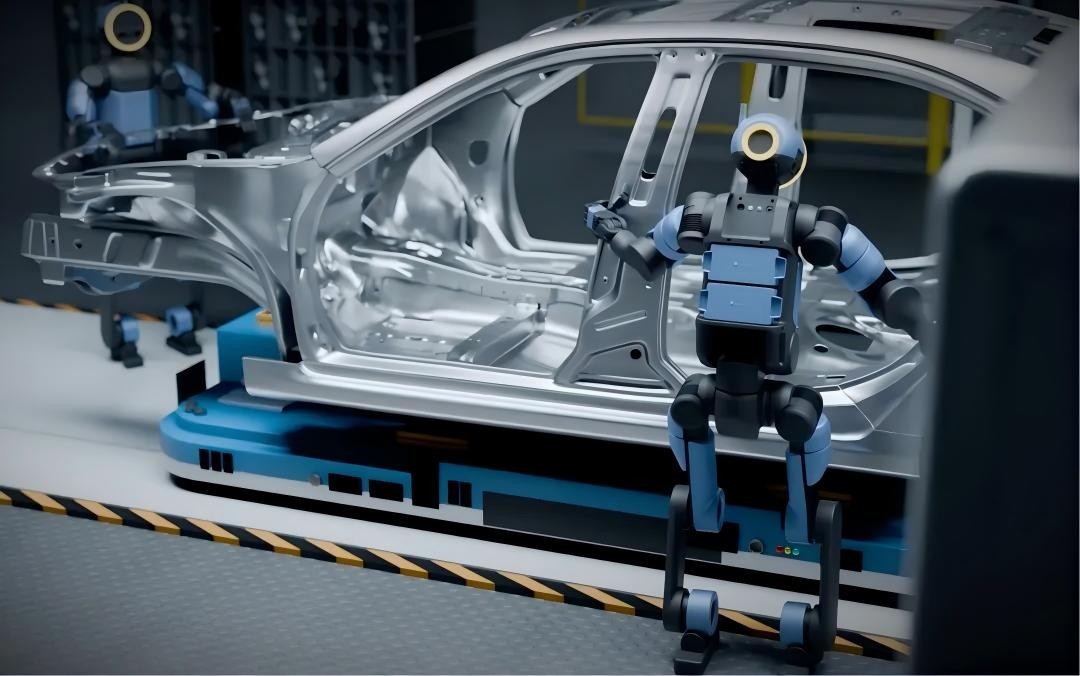
Harmonic joint modules are typically installed in the arms and waist of humanoid robots.
From a performance perspective, the new harmonic joint modules mentioned above all emphasize reductions in weight and volume, as well as improvements in power density, torque density, positioning accuracy, and torque. Some companies also highlight improvements in protection rating, thermal efficiency, and reduced torque ripple.
Further reductions in weight and volume amplify the advantages of harmonic joint modules in humanoid applications, while improved positioning accuracy helps humanoid robots perform specific tasks more precisely.
Improvements in protection rating and thermal efficiency serve as remedial measures for material fatigue and susceptibility to damage in such products.
Notably, through performance optimization, harmonic joint modules are gradually absorbing and integrating certain advantages of planetary joint modules in specific aspects.
Planetary joint modules have long offered significant flexibility advantages, particularly for robot legs and fingers where speed is critical. They feature high load capacity, strong wear resistance, and low reduction ratios.
Looking at new planetary joint module products in 2025, weight reduction remains a key focus, mainly achieved through new lightweight materials, compact structural design, and improved space utilization. In terms of performance, cooling and noise reduction, high thrust density, and peak torque improvements have become new breakthrough points.
It is clear that planetary joint modules are also evolving technologically, continuously catching up with and moving closer to the advantage areas of harmonic joint modules.
This is good news. From the technological competition and cooperation surrounding joint modules—the “hidden protagonists”—it can be seen that none of the new products are the result of isolated hardware breakthroughs. Rather, they represent a systematic engineering effort driven by complete robot requirements and coordinated upstream and downstream evolution.
At the same time, traditional component manufacturers with large-scale manufacturing and cost-control capabilities are entering the field strongly, providing robust supply chain support and signaling the potential acceleration of humanoid robot commercialization.
In the future, as joint modules continue to break through in precision, load capacity, and energy consumption, the motion capabilities and application scenarios of humanoid robots will expand significantly. The foundation of all this lies deep within these joints that never stop moving.
Compared with requiring robot manufacturers to define what kind of joint modules core component suppliers should make, robot manufacturers are more eager for suppliers to proactively introduce products that truly break current performance boundaries and raise the upper limits of humanoid robot capabilities.
 GUANGZHOU HAOZHI INDUSTRIAL CO., LTD.